
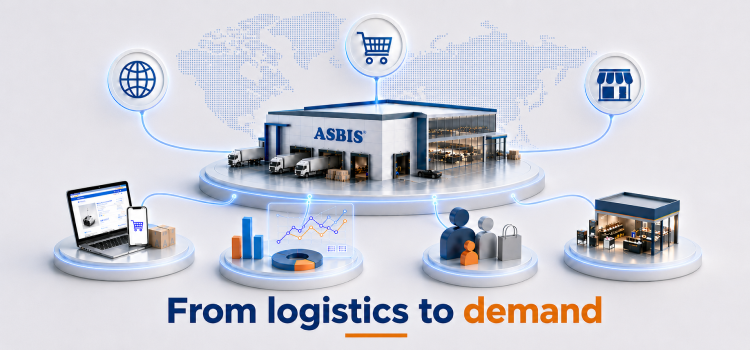
The Role of the Distributor in the Consumer Segment: From Logistics to Demand Management
Author: Vladimir Linkevich, CBDO Consumer Distribution at ASBIS Group
For many years, the role of a distributor in the consumer segment was described in simple terms: bring the product in, keep it available, deliver it on time, and make sure the supply chain works without disruption. All this still matters. Without reliable logistics, financial discipline, and proper stock planning, consumer distribution cannot function.
But today, logistics is only the starting point.
The consumer segment has become faster, more competitive, and much less predictable. Customers compare products instantly, follow prices online, read reviews, switch between brands, and expect availability almost immediately. Retailers and marketplaces compete not only on price, but also on assortment, content, delivery speed, customer experience, and promotional mechanics. Vendors, in turn, need more than market coverage. They need their products to be launched correctly, represented properly, and adapted to the realities of each local market.
This is why the role of the distributor is changing. It is moving from logistics to demand management — and, just as importantly, to connecting markets.
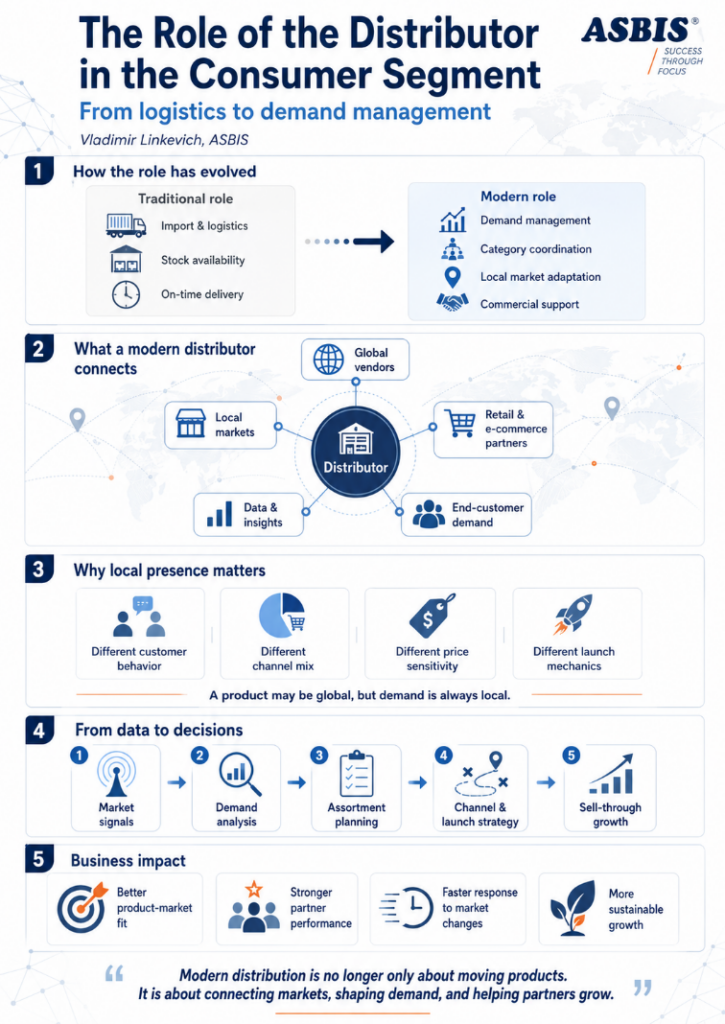
Distribution no longer ends at the warehouse
In consumer business, having a product in stock does not automatically mean it will sell. A company can bring in the right product, but miss the season. It can offer a competitive price, but choose the wrong channel. It can build a wide product matrix, but fail to explain to partners why this product matters and how it should be sold.
Strong distribution today is not only about availability. It is about understanding what is happening behind demand.
Which categories are growing? Where is demand stable, and where is it driven by promotions? Which products work better in offline retail, and which ones are better suited for e-commerce? What matters to customers in one country, and what may be less important in another?
These questions are now part of the distributor’s everyday work.
Local presence makes the difference
Consumer markets cannot be managed through one universal regional plan. Two countries may look similar on paper, but demand can behave very differently. In one market, customers may be more open to premium products and new technologies. In another, price sensitivity may be the main driver. Somewhere, offline retail remains decisive. Elsewhere, online channels and marketplaces set the pace.
This is why local presence is not just geography. It is a business advantage.
For ASBIS, working across many markets means combining international scale with local knowledge. Local teams understand how partners plan their assortment, which marketing tools work, where demand is forming, and what kind of support is needed to turn product availability into real sales.
At the same time, ASBIS can connect this local insight with broader regional experience. Vendors need access to markets, but they also need to understand how those markets really work. Partners need products, but they also need confidence that the assortment, pricing, and supply logic fit their local reality.
The distributor sits exactly at this intersection.
From data to commercial decisions
Consumer business generates a huge amount of data: sales, stock levels, channel dynamics, seasonality, promotional activity, price changes, and competitor moves. But data alone does not create value. Value appears when data is turned into decisions.
If demand is growing in a category, the task is not simply to order more products. We need to understand what is driving the growth. Is it a short-term promotion effect? A sustainable trend? A reaction to a new product line? A change in consumer habits? Or a temporary shortage among competitors?
The answer affects everything: purchase volume, delivery timing, allocation by country, channel strategy, marketing support, and partner recommendations.
A strong distributor today does not only react to what has already happened. It helps the market prepare for what may happen next.
Partners need commercial logic, not just stock
Retailers and e-commerce partners today are under constant pressure. They need to manage assortment, turnover, margins, marketing, customer experience, and competition between channels. That is why they expect more from a distributor than a price list and warehouse availability.
They need clear commercial logic: which products should be added to the assortment, which models deserve focus, where there is growth potential, which categories can be developed further, and what kind of offer will be relevant to a specific audience.
This is the essence of the shift from supply to demand management. The distributor helps the partner not only buy the product, but also sells it effectively and makes money from it.
This can include category analytics, assortment recommendations, support for product launches, joint marketing activities, work with promotions, team training, and adaptation of materials for local markets.
For vendors, the distributor is a route to the market
For manufacturers, entering regional markets is not only about finding local partners. Each market has its own purchasing power, channel structure, competitive environment, service expectations, seasonality, and communication habits.
A global brand strategy is important, but locally it must be translated into the language of a specific market.
This is where the distributor plays a key role. It understands how local channels work, which partners are strong in which categories, which promotion formats are effective, and where risks may appear.
For vendors, this is especially valuable because the distributor sees not only one brand, but the whole category. It understands what is happening on the shelf, online, in partner purchasing decisions, and in the behavior of the end customer.
In practice, this helps avoid a common mistake: assuming that the same product strategy will work everywhere. It rarely does.
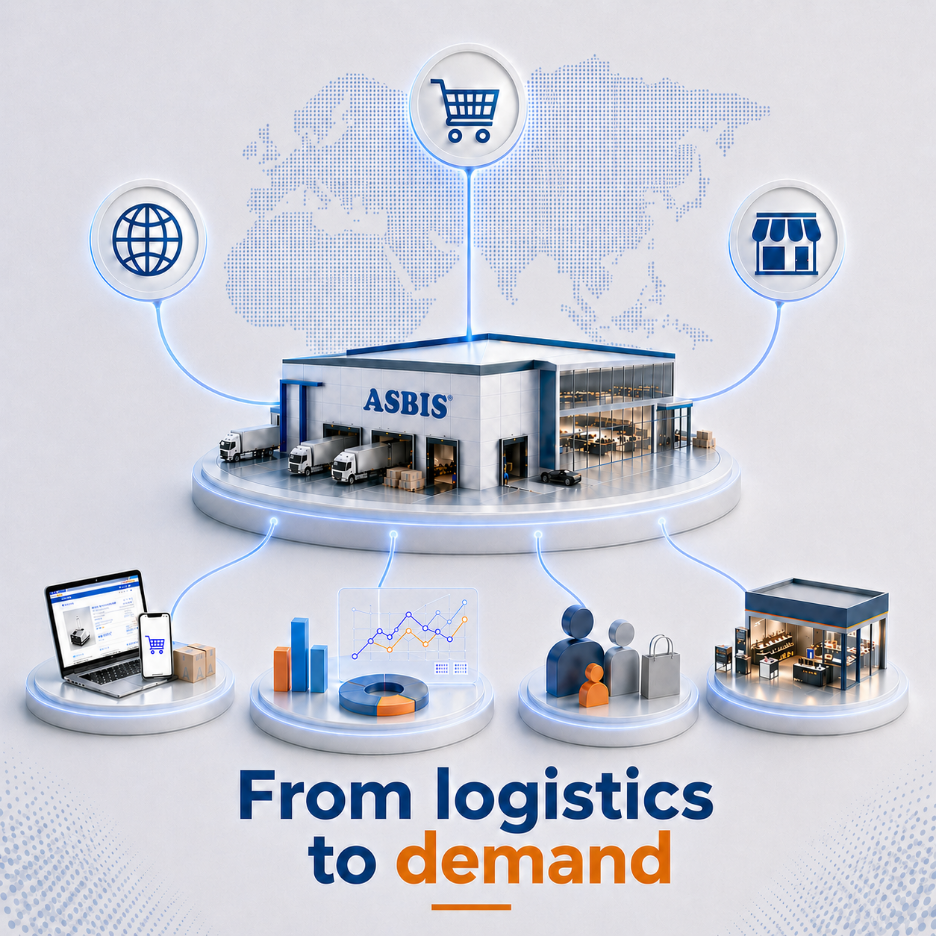
The future of distribution is the ability to connect
The distributor’s role today is to connect. But not only the vendor and the partner.
It means connecting global brands with local markets. Regional scale with local execution. Data with commercial decisions. Logistics with marketing. Assortment with real demand.
This is why modern distribution has become much more than moving products through the chain. It is still about reliable supply, operational efficiency, and financial stability. But it is also about helping the market grow in a more deliberate and structured way.
In the consumer segment, the winner is not simply the one who delivers the product faster. The winner is the one who better understands who needs this product, when they need it, through which channel, in which market, and with what offer.
Modern distribution is no longer only about logistics. It is about demand management, category expertise, local presence, and the ability to connect markets into one working ecosystem.