
The evolution of IT distribution: from product supply to solution-driven infrastructure
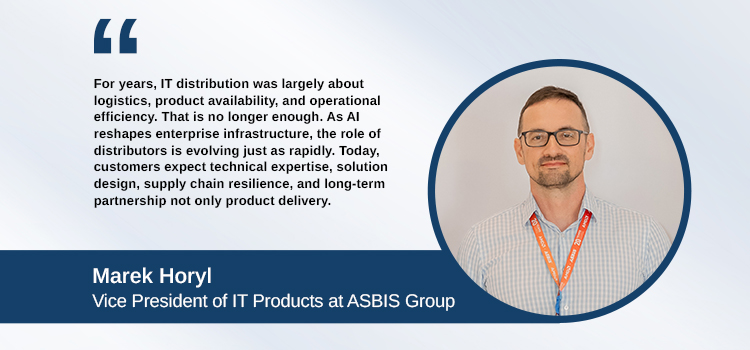
In our latest interview with Marek Horyl, Vice President of IT Products at ASBIS Group, we explore how AI is changing the distribution landscape, why infrastructure projects have become significantly more complex, and what this means for the future of the IT channel.
Q: You have been active in IT distribution for more than two decades. How has the role of distribution changed during that time?
M. H.: The role of IT distribution has fundamentally transformed. Twenty years ago, distribution was primarily focused on logistics, availability, financing, and transactional volume.
Success was measured by how efficiently you could move boxes through the supply chain. Today, the market is dramatically more complex. Customers expect complete solutions, technical expertise, consulting capabilities, and long-term support.
Modern IT infrastructure projects are no longer about individual hardware components. They involve the integration of compute, storage, networking, virtualization, cybersecurity, cloud services, and increasingly AI capabilities.
As a result, distributors must evolve from logistics providers into technology enablers and strategic partners.
At ASBIS, we see this transition very clearly. The market is shifting toward project-based and solution-oriented business models, especially in enterprise infrastructure, data centers, and AI-related deployments.
Our role today is not only to supply technology, but to help partners design architectures, optimize infrastructure, secure component availability, and support increasingly sophisticated customer requirements.
Q: How is AI changing the distribution landscape?
M. H.: Artificial intelligence is probably the largest structural change our industry has experienced in decades. AI is reshaping demand patterns across the entire infrastructure ecosystem.
We are seeing explosive growth in demand for GPU-accelerated servers, enterprise storage, high-speed networking, HBM memory, enterprise SSDs, and AI-ready compute platforms.
According to recent industry data, the five largest AI companies – Amazon, Microsoft, Google, Meta, and Oracle – are expected to collectively invest around USD 700 billion into AI infrastructure in 2026 alone.
This level of investment creates enormous pressure across global supply chains. Manufacturing capacity is increasingly being redirected toward AI and data center infrastructure, while traditional PC-related production receives lower priority.
We already see situations where advanced memory technologies like HBM and DDR5 are heavily allocated to hyperscale AI deployments, creating shortages and pricing pressure across the broader market.
For distributors, this changes everything. Supply chain management becomes a strategic capability. Forecasting, allocation management, vendor relationships, logistics resilience, and technical consulting are now core differentiators.
Q: Does this mean the classic broadline distribution model is disappearing?
M. H.: Not entirely. Broadline distribution still plays an important role, especially in scale, operational efficiency, and market coverage. However, the value creation increasingly comes from specialization and technical capabilities.
At ASBIS, we combine the scale advantages of broadline distribution with strong specialization in enterprise infrastructure, AI platforms, storage, networking, and data center solutions.
We are investing heavily into technical teams, pre-sales competencies, solution architecture support, and vendor-certified expertise.
This allows us to support partners not only commercially, but also technologically. The industry is moving toward high-value distribution models where integration of hardware, software, and services becomes essential.
Q: What does this transformation look like internally within ASBIS?
M. H.: Internally, the transformation has been significant. Over the past years, ASBIS evolved from a traditional component-focused distributor into a much broader technology ecosystem.
Today we operate across more than 30 countries in EMEA with centralized vendor management, regional logistics hubs, enterprise-focused technical teams, and strong relationships with key global technology vendors. Our portfolio now includes enterprise servers, storage systems, networking technologies, cybersecurity solutions, cloud platforms, and AI infrastructure components.
One important aspect is our logistics capability. The Prague distribution center, which was significantly expanded in 2024, now serves as one of the key logistics hubs for the EMEA region. Last year alone, products exceeding USD 2.2 billion passed through this facility.
While our other three new distribution centres in Dubai, UAE; Johannesburg, SA and Georgia are also fully utilized.
At the same time, we are expanding our role in strategic infrastructure projects. AI-related deployments require much deeper collaboration between distributors, system integrators, cloud providers, and enterprise customers than traditional IT projects ever did.
Q: Where do you see IT distribution heading over the next few years?
M. H.: I believe the role of distribution will continue evolving toward orchestration and enablement. The infrastructure ecosystem is becoming too complex for purely transactional business models.
Distributors will increasingly act as connectors between global vendors, cloud providers, integrators, and enterprise customers. Technical expertise, financing capabilities, logistics resilience, and supply chain visibility will become more important than pure scale.
The next few years will also be shaped by continued AI investment cycles. Demand for compute power, enterprise memory, accelerated networking, and scalable storage will remain extremely strong. According to industry expectations, global IT spending may exceed USD 4.25 trillion in 2026, largely driven by AI infrastructure investments. In this environment, companies that can combine global scale with regional flexibility and technical competencies will be in the strongest position.