
Building infrastructure for the AI era: challenges and opportunities
ASBIS launches a new AI infrastructure insights interview series. As artificial intelligence reshapes the global IT landscape, the infrastructure layer is undergoing one of the most significant transformations in decades, from compute and storage architectures to supply chains, deployment models, and customer expectations.
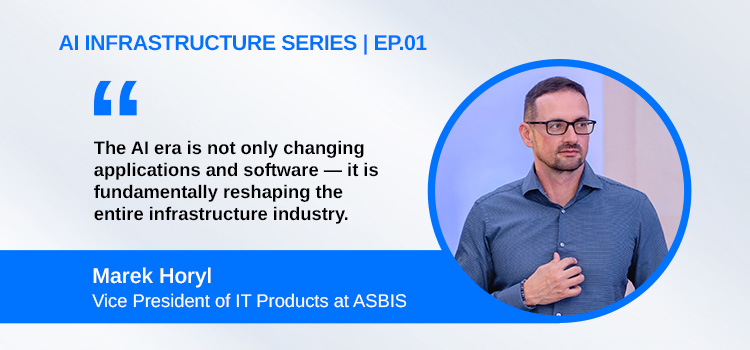
To explore these changes in depth, ASBIS is launching a new series of executive interviews featuring industry experts and internal leaders. The format focuses on short, high-signal conversations around the key forces driving the next phase of enterprise infrastructure evolution AI workloads, supply constraints, hybrid architectures, and long-term ecosystem shifts. The series is designed to bring clarity to an increasingly complex market environment and to share practical perspectives on how organizations can adapt to accelerating AI infrastructure demand and structural industry change. The first interview in the series with Marek Horyl, Vice President of IT Products at ASBIS is published below.
Q: Modern IT infrastructure is becoming increasingly complex. How do you see this evolution?
M. H.: The complexity is increasing dramatically. Traditional infrastructure environments were relatively predictable – servers, storage, networking, virtualization, and business applications.
Today, AI changes the equation entirely.
AI workloads require massive compute density, GPU acceleration, high-speed interconnects, advanced cooling, ultra-fast storage, and enormous memory bandwidth. Infrastructure architectures are becoming significantly more demanding from both technical and operational perspectives.
At the same time, customers expect scalability, energy efficiency, resilience, security, and very fast deployment timelines.
This creates a completely new infrastructure environment.
Q: What are the biggest challenges companies face today?
M. H.: One of the biggest challenges is balancing performance requirements with supply constraints and rising infrastructure costs.
The AI boom is putting unprecedented pressure on the semiconductor ecosystem. Advanced packaging, HBM memory, enterprise SSDs, and GPU manufacturing capacity are heavily constrained globally. We are seeing conditions comparable to pandemic-era supply chain disruptions.
Another challenge is forecasting. Infrastructure investment cycles are becoming more aggressive and less predictable. Large hyperscale AI projects can absorb enormous amounts of global component supply within very short periods.
This requires much closer cooperation across the entire ecosystem – vendors, distributors, integrators, cloud providers, and enterprise customers.
Q: Are customer expectations changing as well?
M. H.: Absolutely. Customers today expect infrastructure partners to provide complete solutions, not just hardware products.
Organizations want help with architecture design, workload optimization, deployment strategies, scalability planning, financing, and long-term operational support.
There is also growing demand for flexibility. Hybrid cloud models, edge AI deployments, sovereign cloud requirements, and regional data center strategies are becoming increasingly common.
The conversation is shifting from “what hardware should we buy” to “how do we build infrastructure that supports long-term business transformation.”
Q: How is ASBIS adapting to these requirements?
M. H.: At ASBIS, we are heavily investing into technical competencies, enterprise-focused teams, and infrastructure partnerships.
We are strengthening our capabilities across AI-ready servers, enterprise storage, networking, and data center solutions. Equally important is our investment into logistics and supply chain resilience.
Recent global disruptions clearly demonstrated how critical resilient supply chains have become. Geopolitical tensions, component concentration among a small number of suppliers, and advanced manufacturing dependencies all create structural risks for the industry.
This is why operational agility and vendor relationships are now strategic assets.
Q: How do you see the next 2–3 years developing?
M. H.: The next few years will likely represent the most intensive phase of AI infrastructure expansion.
We expect continued growth in enterprise AI deployments, hyperscale investments, edge infrastructure, and regional data center ecosystems. At the same time, supply constraints and pricing pressure may remain elevated across critical infrastructure components.
According to current industry outlooks, no major supply relief is expected before 2028.
This means the market will increasingly reward companies capable of:
- securing strategic supply,
- optimizing infrastructure efficiency,
- supporting complex deployments,
- and managing large-scale technology ecosystems.
For ASBIS, the focus will remain on enterprise infrastructure, AI enablement, supply chain excellence, and long-term partnerships across the EMEA region.
The AI era is not only changing applications and software – it is fundamentally reshaping the entire infrastructure industry.