
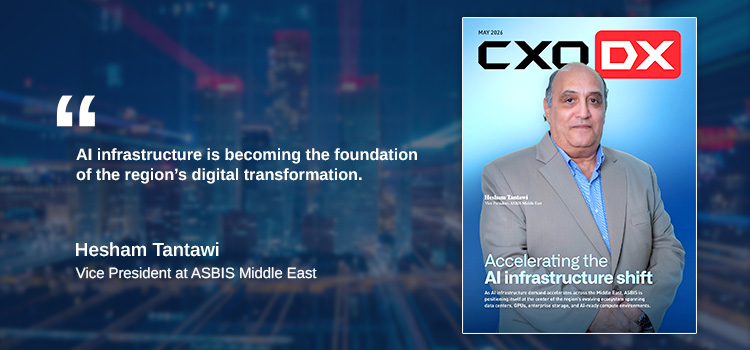
AI Infrastructure Boom Reshapes Middle East Technology Landscape
In a recent interview, Hesham Tantawi, Vice President at ASBIS Middle East, outlined the major trends driving the rapid transformation of AI infrastructure across the Middle East and Africa.
According to Mr. Tantawi, the market is currently being shaped by three key developments: the accelerated growth of AI-ready data centers and “AI factories,” the industry-wide shift toward open and customizable infrastructure architectures, and rapidly increasing demand for enterprise storage driven by hyperscalers and sovereign AI initiatives.
“The distribution landscape is changing significantly,” said Tantawi. “While ASBIS has always been a volume-focused distributor, today the volume itself has shifted toward data center infrastructure, enterprise servers, AI systems, and large-scale computing environments.”
As governments, enterprises, and cloud providers continue investing in localized AI ecosystems, demand is rising across the entire infrastructure stack, including CPUs, GPUs, SSDs, enterprise storage, and high-performance servers.
One of the most significant market shifts identified by Tantawi is the emergence of “AI factories” — dedicated environments built specifically to support compute-intensive AI workloads and next-generation enterprise applications.
“Governments and enterprises are now actively building their own AI engines and environments internally,” he explained.
ASBIS continues to strengthen its position within the AI infrastructure ecosystem through partnerships with leading technology vendors including NVIDIA, AMD, Intel, Micron, Seagate, Toshiba, and Supermicro.
Tantawi also highlighted a broader transition away from traditional OEM-centric infrastructure models toward more flexible and customizable environments, where enterprises increasingly source components directly to optimize systems for their own workloads.
“Two years ago, people were demanding servers from many original manufacturers. Today they are moving toward more open sources,” he noted.
At the same time, the interview underscored mounting pressure on the global enterprise storage market. According to Tantawi, hyperscale cloud providers are consuming a substantial share of worldwide storage manufacturing capacity, creating supply constraints and allocation challenges across the industry.
“Most of the hard drive manufacturers are effectively pre-sold until 2027,” he said.
The company expects the UAE and Saudi Arabia to remain the primary growth engines for AI infrastructure investments in the region, while Africa continues to emerge as an important strategic expansion market for ASBIS.
Looking ahead, ASBIS anticipates continued momentum around AI factories, enterprise-owned infrastructure, localized compute environments, and next-generation data center investments across the Middle East and Africa.
Read the interview: CXO DX May 2026 by Leap Media Solutions – Issuu