
Beyond the Box: Why Post-Sales Defines the Future of IT Distribution
This material is authored by Alexander Mazko Chief Post-Sales Service Officer, offering executive insights into how modern IT distribution is evolving beyond logistics into managed service ecosystems.
In modern IT infrastructure, delivery is no longer the differentiator. Service is.
For years, IT distribution was measured by logistics efficiency: inventory availability, shipment speed, pricing, and geographic reach. That model no longer reflects how enterprise technology ecosystems operate.
Today, the real test begins after deployment. When infrastructure fails, replacement cycles slow down, vendor policies conflict with local market realities, or enterprise customers face operational downtime, distribution becomes something far more strategic than product movement. It becomes risk management.
In multi-vendor environments especially, post-sales capabilities increasingly determine whether a technology partnership strengthens customer loyalty or quietly destroys it.
The End of Transactional Distribution
Modern enterprise infrastructure is built across increasingly complex ecosystems: servers, devices, processors, networking equipment, cloud layers, and hybrid workplace technologies operating simultaneously across multiple brands and jurisdictions. In that environment, the traditional “ship-and-forget” distribution model creates friction almost immediately. Each vendor has different service standards. Each country operates under different consumer protection regulations. Each partner has different operational capabilities. And each customer expects fast resolution regardless of where responsibility sits inside the supply chain. The result is a growing gap between manufacturer policies and real-world customer expectations. That gap is where value-added distribution either proves its relevance or loses it.
Why Support Delays Cost More Than Hardware Failure
Most customers do not buy technology products for the products themselves. They buy continuity.
A device, server, processor, or infrastructure component exists to support business operations, communication, productivity, or revenue generation. The moment that system becomes unavailable, the financial impact extends far beyond the technical issue itself.
Downtime introduces operational disruption. Operational disruption creates stress. And unresolved stress rapidly becomes reputational damage.
In enterprise environments, the cost of delayed support often exceeds the cost of the original incident. This is precisely why post-sales service has evolved from a support function into a business-critical discipline.
Reactive Support No Longer Scales
Traditional reactive support models were designed for simpler supply chains and slower customer expectations. Modern infrastructure environments require something different: managed incident ecosystems built around predictability, prevention, and risk reduction.
The distinction is critical. Reactive support responds after failure occurs. Managed incident management anticipates operational risk before escalation happens.
That shift changes everything:
- spare-parts planning,
- buffer stock strategy,
- preventive maintenance,
- localized service operations,
- extended service packages,
- replacement logistics,
- escalation frameworks.
The objective is no longer simply to “fix problems.” The objective is to minimize business interruption altogether.
Why Two Identical Deliveries Can Produce Completely Different Business Outcomes
Two distributors can deliver the same product to the same market under the same commercial conditions and still create completely different long-term results. The difference is service architecture.
In one scenario, the distributor transfers the manufacturer’s service policy “as is,” leaving the reseller fully exposed to customer dissatisfaction. In another, the distributor actively adapts service operations to local market realities, aligns expectations between vendor and partner, and builds support mechanisms that preserve customer trust when incidents occur.
That distinction directly affects:
- customer retention,
- partner loyalty,
- brand perception,
- renewal cycles,
- ecosystem growth.
Because customers rarely judge a brand during successful operation. They judge it when something goes wrong.
Distribution as a Brand Experience
Post-sales service is no longer operational infrastructure hidden behind the business. Increasingly, it becomes part of the brand itself. A customer who experiences transparent communication, fast escalation management, and predictable resolution is significantly more likely to remain loyal to both the reseller and the technology ecosystem behind it.
Conversely, poor service experiences damage not only the reseller relationship, but the manufacturer’s reputation as well. This is especially visible in highly competitive consumer and enterprise technology markets where replacement decisions happen quickly and switching costs continue to decrease. Service quality has become a brand retention strategy.
The Localization Challenge
Global technology vendors often operate through standardized international service policies. But enterprise realities are local. Consumer law differs by country. Partner expectations differ by region. Operational infrastructure differs by market maturity. This creates one of the most underestimated responsibilities inside modern distribution: localization of service logic.
Effective value-added distributors increasingly act as operational translators between global manufacturers and local market realities – balancing compliance requirements, customer expectations, and commercial sustainability simultaneously. That role is becoming strategically indispensable.
Delivery Is Only 30% of Project Success
Hardware delivery without service strategy creates risk for every participant in the ecosystem. For the end customer, it damages trust in the technology investment. For the reseller, it creates financial and reputational exposure. For the vendor, it weakens long-term brand loyalty. And for the distributor, it threatens the stability of the entire partner network. The industry is moving toward a much clearer understanding:
Logistics may start the customer relationship. But post-sales service determines whether that relationship survives.
Beyond the Box
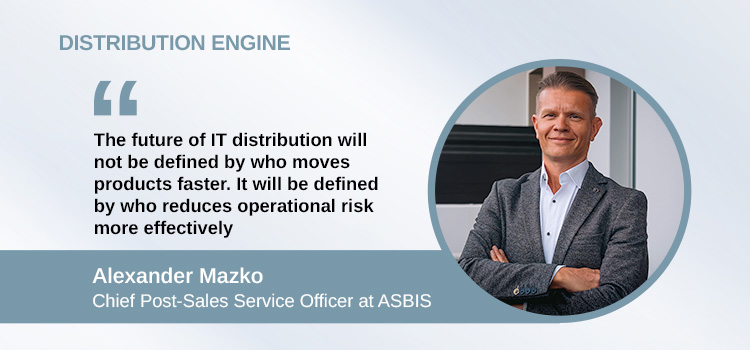
The future of IT distribution will not be defined by who moves products faster. It will be defined by who reduces operational risk more effectively. In an industry increasingly shaped by ecosystem complexity, customer expectations, and infrastructure dependency, post-sales service is no longer an additional function. It is the business model itself.