
Blend Energy: developing a new approach to plastic recycling
Plastic waste remains a major challenge for the recycling industry. Conventional mechanical recycling works well for many clean and separated plastic streams, but mixed materials, contamination and additives can significantly limit what can be processed this way. As a result, large volumes of plastic still remain outside effective recycling systems. In 2026, an estimated 130 million tonnes of plastic waste are unmanaged or improperly discarded worldwide, according to the World Economic Forum.
Blend Energy, a technology company in ASBIS investment portfolio, develops an industrial solution for plastic waste that is difficult to recycle through conventional methods. Based in Cyprus, the company designs and manufactures compact thermolysis systems that convert suitable plastic waste into hydrocarbon oils for further use in chemical manufacturing and energy applications.
We spoke with Daniel Davidov, founder and CEO of Blend Energy, to look at the project in more detail: how the idea started, how the technology has developed, what happens to plastic inside the thermolysis system, and how many years of engineering work have brought Blend Energy to its current industrial stage.
“Plastic is made from oil, and after years in oil and gas I couldn’t accept that we were burying or burning it. Mechanical recycling needs clean, sorted plastic, but most real waste isn’t like that. We set out to build a system that takes that difficult plastic and turns it back into a feedstock for new production.”
— Daniel Davidov
From early experiments to industrial scale
The first experiments demonstrated that mixed plastics could be converted into usable hydrocarbon fractions, but this was only the starting point. The real engineering challenge was to make the process continuous, stable and controllable when working with real waste streams, where the composition and behaviour of the feedstock can vary considerably.
Blend Energy therefore developed the technology as a complete processing system rather than simply a reactor. Material preparation and feeding, thermal decomposition, treatment and recirculation of process gases, condensation and purification all had to operate as parts of one controlled process. The first complete skid-based system demonstrated continuous thermolysis in 2019, and subsequent generations of the equipment were developed around greater thermal stability, process control and reliable operation with mixed-plastic feedstock. By 2021-2023, the company had reached industrial-scale multi-hour operation using real material rather than controlled laboratory samples.
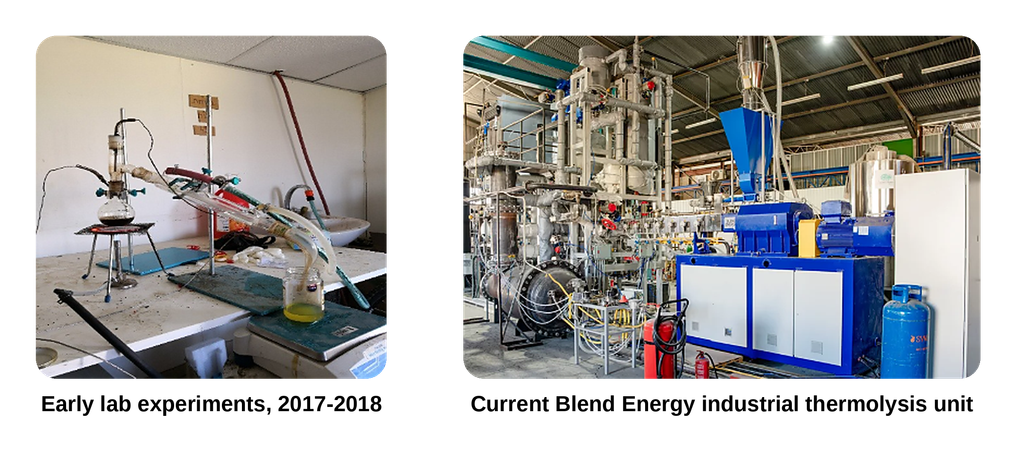
“Proving that plastic can be turned into oil was the easy part. Chemists have known that for decades. The hard part is doing it continuously, day after day, with real waste that changes from one bag to the next. Laboratory samples are clean and predictable, and real feedstock never is. Moisture, labels, PVC and dirt all change how the material behaves inside the reactor. Most of our engineering went into feeding, heat control and gas handling, not the reactor alone. The turning point was when we ran for hours on real mixed waste, stopped, restarted and got the same result. That was when it stopped being an experiment and became a machine.“
— Daniel Davidov
ASBIS had been following Blend Energy’s development for approximately 12 months before investing in the company in December 2023. At that point, the technology had already gone through several generations of equipment and had demonstrated continuous operation at industrial scale. The investment was Blend Energy’s first external capital and gave the company additional resources to continue developing the technology, expand its production capabilities and prepare for international deployment.
“ASBIS came in as our first external investor, after watching us closely for about a year. That mattered to us, because they invested in a technology that was already working, not in a presentation. The investment let us move from building units one at a time to thinking like a manufacturer: certification, standardised design, a proper supply chain and a team that can deliver projects abroad. It gave us the stability to focus on engineering for the long term instead of just the next test.”
— Daniel Davidov
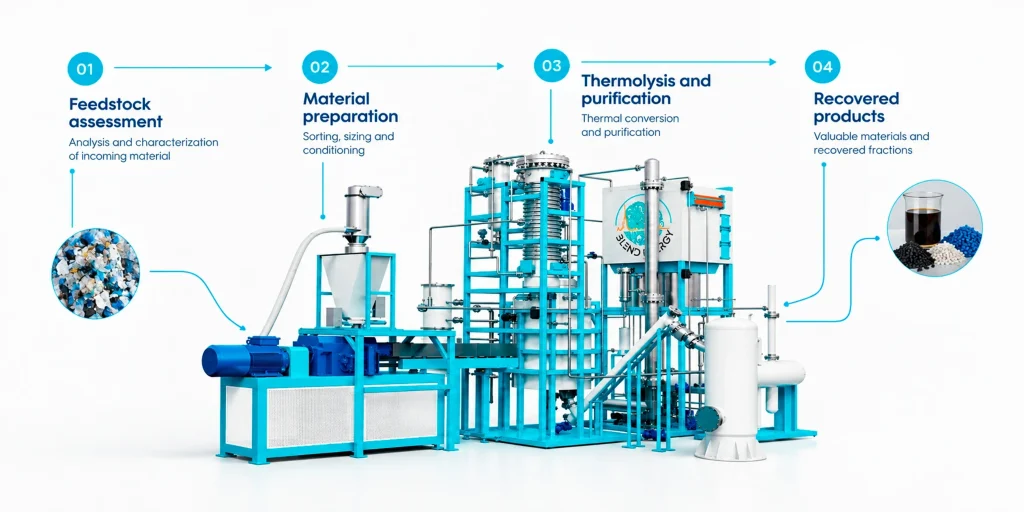
Today, Blend Energy’s compact modular system is designed to process up to 2.4 tonnes of plastic waste per day. The process covers feedstock assessment and preparation, thermal decomposition without oxygen, treatment and recirculation of process gases, condensation and purification. The recovered hydrocarbon oils can be used in chemical manufacturing or energy applications depending on their properties and the project configuration, and an optional CO₂ capture module can be integrated into the system.
Extending technology beyond plastic recycling
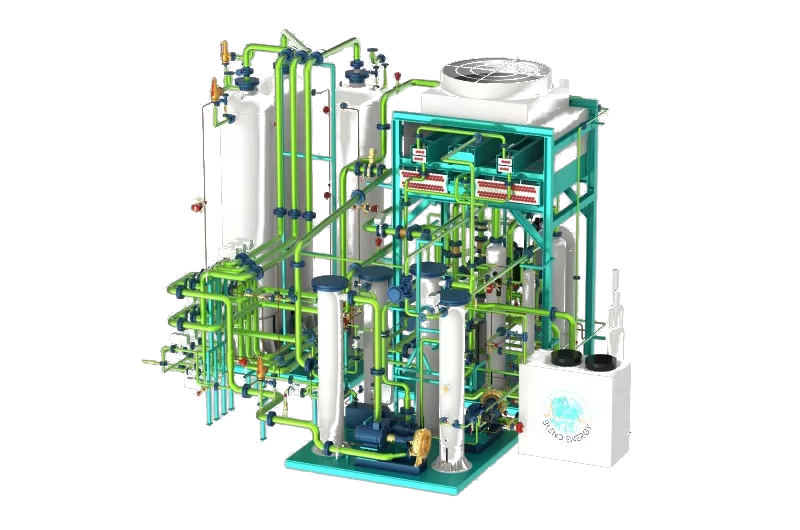
Blend Energy is extending its technology platform with a modular CO₂ capture system designed to work directly with the thermolysis process. The unit separates CO₂ from process gases using zeolite-based Pressure Swing Adsorption, adding carbon management to the same industrial setup used for plastic recovery.
The first prototype was tested in 2020. Today, Blend Energy has a full-scale CO₂ capture system undergoing live testing and fine-tuning. For industrial projects, the module can be integrated where additional carbon management is required, combining the recovery of hydrocarbon products from difficult plastic waste with CO₂ separation within the same technology platform.
“Our customers don’t just want to deal with plastic waste. They want to do it with the lowest possible footprint. Thermolysis already recirculates its own process gases, so the CO₂ is concentrated in one place where we can capture it, rather than letting it escape. It made sense to build the capture module ourselves so that it fits the process instead of being bolted on afterwards. For a project developer, it means one platform that recovers value from waste and manages carbon at the same time.“
— Daniel Davidov
Next stage of development
Today, Blend Energy offers ready industrial solutions for waste-management operators, industrial companies and project partners dealing with mixed and contaminated plastic waste that cannot be recycled effectively through conventional mechanical methods. Its compact modular thermolysis system converts suitable waste into hydrocarbon oils for further use in chemical manufacturing and energy applications, with internal recirculation of process gases and the option to integrate CO₂ capture. The system can be configured around the characteristics of the feedstock and the requirements of a specific project.
For companies dealing with difficult plastic waste, this creates an additional recycling route where conventional methods have clear limitations. Instead of losing the material from the recycling cycle, valuable hydrocarbons can be recovered and returned to industrial production as a secondary raw material.
Blend Energy is now focused on expanding the technology across new markets and industrial applications. The company plans to work with a broader range of feedstocks and continue developing CO₂ capture, extending the capabilities of the system beyond its current applications. With the core technology already operating at industrial scale, the next phase is about bringing it to a wider range of projects and markets.
“The technology is proven. The next challenge is scale. Plastic waste is a local problem everywhere, and our systems are compact and modular, so they can be installed close to where the waste is produced. But we are looking beyond plastic recycling. We already have a platform for capturing CO₂ from the process, and we’ve completed the conceptual engineering for the next step: using that captured CO₂ to grow algae. The plastic becomes oil for new production, the CO₂ feeds the algae, and the algae becomes a resource in its own right. That’s the full circle we’re working towards, where every output of the process has a use and nothing is wasted.”
— Daniel Davidov