
AI’s new infrastructure challenge: Why deployment has become the real bottleneck
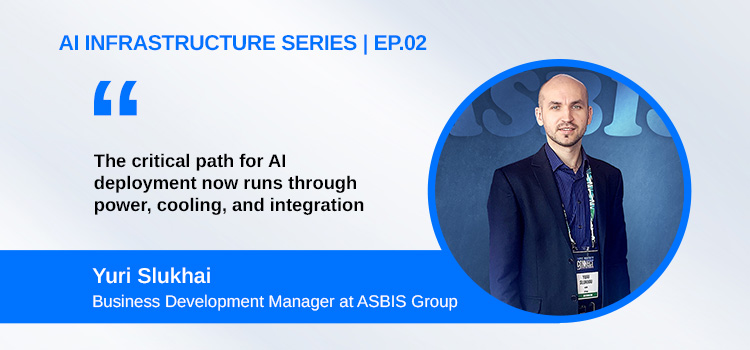
In this article, Yuri Slukhai, Business Development Manager at ASBIS Group, explores how the primary constraint in AI adoption is shifting from compute availability to infrastructure deployment. As organizations accelerate AI investments, growing pressure on power capacity, cooling systems, supply chains, and facility readiness is extending deployment timelines and increasing complexity across the ecosystem.
The hidden bottleneck in AI infrastructure is no longer compute. It’s infrastructure delivery.
For years, the conversation around AI scale focused on one constraint: GPU availability. While accelerators remain critical, the reality across enterprise and hyperscale deployments has evolved.
Today, many organizations can secure compute resources. The challenge is bringing AI infrastructure online on time, at scale, and with the power, cooling, and integration capabilities modern AI workloads require.
According to recent industry reports from JLL and ArchDesk, AI infrastructure procurement cycles that traditionally took 3-6 months are now extending to 12-18 months in many deployments.
The reason is not slowing demand. It’s growing pressure across the entire AI infrastructure supply chain.
Key challenges include:
- Critical infrastructure lead times extending to 12–36 months, with components such as substation transformers often exceeding 52 weeks for delivery.
- AI-ready rack densities reaching 40–160 kW per rack, compared to 5–10 kW in traditional enterprise environments.
- Global data center electricity consumption projected to reach 1,050 TWh by 2027, driven by AI accelerators consuming 700–1,200 W per device.
- AI facility construction costs exceeding $25M per MW, while liquid-cooling infrastructure alone can require $4.5–5.2M per MW.
- Strong market expansion, with the AI data center sector projected to grow at a 14.3% CAGR and reach $241.56B by 2034.
This is changing the role of distribution. It has become a critical coordination layer between technology vendors, system integrators, infrastructure providers, and end customers, aligning component availability, deployment schedules, power readiness, cooling capacity, and integration requirements.
In today’s environment, successful AI deployment is not defined solely by access to compute.
It is defined by the ability to orchestrate the entire infrastructure stack, from silicon and servers to racks, networking, power, and cooling.
AI infrastructure continues to scale rapidly.
But the industry’s most significant constraint is increasingly moving upstream: from compute availability to the complex ecosystem required to deploy it.
The future of AI infrastructure will be defined not only by compute performance, but by the ability to orchestrate the entire ecosystem behind it.
At ASBIS, we work with leading technology vendors and partners to help bridge the gap between AI ambition and AI deployment, aligning infrastructure, supply chains, and operational readiness to bring AI projects online faster and more efficiently.
These topics will also be part of the conversations taking place at ISC High Performance 2026 in Hamburg, where the ASBIS team will be engaging with customers and partners on the future of AI infrastructure, data center modernization, and deployment readiness. We look forward to exchanging perspectives on the opportunities and challenges shaping the next phase of AI growth. We invite you to meet us at booth F30.