
Cold Plasma technology: from air treatment to agriculture and medical research
The spread of airborne viruses and other microorganisms remains a significant challenge in shared indoor environments, including hospitals, offices and other public spaces. Existing approaches can reduce the risk, but each has clear limitations.
Air filtration captures particles but does not necessarily neutralise microorganisms. Surface disinfection is effective only where and when treatment is applied, and although UV technologies are capable of inactivating microorganisms, their continuous use in occupied spaces may be unsuitable because of their potential impact on human health. Each approach addresses part of the problem, but none fully resolves the challenge of reducing airborne microorganisms safely and effectively in environments in shared indoor spaces.
Key research and testing results
86.2% reduction in airborne human coronavirus 229E after 15 hours
Measured under laboratory conditions
80 days of testing in COVID wards at Nicosia General Hospital
284 air and surface samples analysed
2 studies published in peer-reviewed scientific journals
Plasma and the challenge of temperature
Plasma is the 4th state of matter and the most common state of matter in the universe. When a gas receives sufficient energy, some of its atoms lose electrons, creating a mixture of charged particles that can conduct electricity and emit light. Plasma occurs naturally in stars and lightning and is also found in technologies such as neon lighting.
The main challenge has traditionally been temperature. Conventional plasma generation requires temperatures of thousands of degrees, making it suitable for industrial applications such as metal cutting but unsuitable for use near people or living cells.
Cold atmospheric plasma provides an alternative. With the appropriate electrical configuration, electrons can be removed from a small proportion of atoms in ordinary air without significantly increasing the temperature of the surrounding air. The process takes place at room temperature and does not produce noticeable heat.
At the same time, the chemical properties of the air change. It contains reactive, electrically charged particles that microorganisms are poorly equipped to withstand. This ability to create reactive chemistry without the extreme temperatures associated with conventional plasma is the principle behind the technology.
6 elements, 5 functions
ASBIS researchers developed a technology that generates plasma using metal salts rather than relying on air alone. This creates a different combination of charged and reactive particles while maintaining a low-temperature process.
The resulting environment may appear completely ordinary, but its chemical composition is different. The air contains reactive and electrically charged particles that can interact with microorganisms. The ability to create this active chemistry without heat is central to the technology.
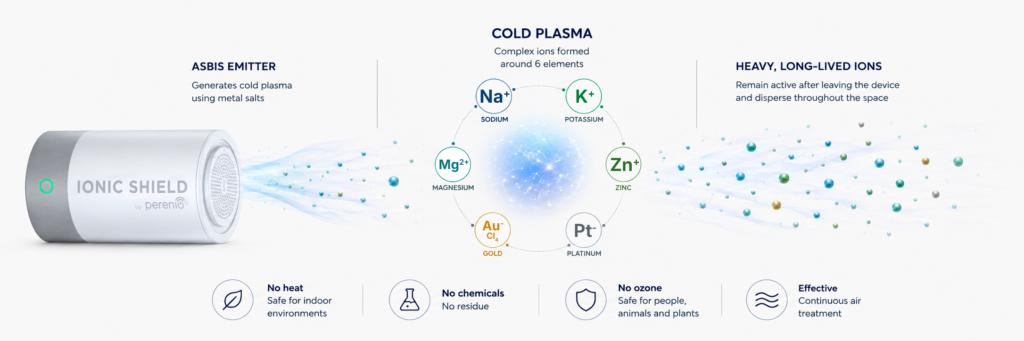
ASBIS emitter forms complex ions around 6 specific elements, each selected for its particular properties. Sodium, potassium, magnesium and zinc, are naturally present in the human body. The other 2, gold and platinum, have long been used in medicine because of their chemical stability and compatibility with living tissue.
- Potassium and sodium are the main ions involved in maintaining fluid and electrolyte balance in the body.
- Magnesium supports tissue repair and enzyme pathways.
- Zinc interferes with viral replication and affects the membranes that hold fungi together.
- Gold interacts with the cell walls of bacteria and fungi and has a long record of being well tolerated by human tissue.
- Platinum supports the production of reactive oxygen species and, in laboratory studies, strengthened the effect of chemotherapy.
There was a second reason for selecting these elements. They form heavy, long-lived ions, meaning their effect does not disappear immediately after leaving the device. In a closed room, charged particles can accumulate and disperse throughout the space, including areas that may not be directly reached by a filter.
Why microorganisms may find it difficult to adapt
Almost every method used to eliminate microorganisms relies on a single mechanism of action. Over time, some microorganisms can adapt to that mechanism, as demonstrated by the development of antibiotic resistance. This is also one of the reasons why the European Union is phasing out routine antibiotics in animal farming.
An ionic field built around 5 different reactive elements introduces multiple mechanisms of action at the same time. For a microorganism to survive, it would potentially need to adapt to all of them simultaneously. This makes resistance far less likely than in the case of a single-target drug or chemical.
Less likely, however, does not mean impossible. No decades-long study has yet been conducted to establish how microorganisms may respond to this type of technology over extended periods of exposure.
From research to a commercial product
The research reached the market in 2021 with PERENIO IONIC SHIELD™, a compact emitter designed and manufactured within the ASBIS Group and now sold across Europe, the Middle East and Africa. The technology behind it is protected by patent GB2597554.
In laboratory testing, it demonstrated activity against human coronavirus and 2 influenza A strains, H3N2 and H1N1.
What the testing actually found
Under laboratory conditions, the emitter reduced airborne human coronavirus 229E by 86.2% over 15 hours. Strain 229E is one of the viruses associated with the common cold and is used in laboratory research as a model for studying related coronaviruses.
The next stage was testing the technology in a hospital environment. Starting in September 2021, emitters operated for 80 days in COVID wards at Nicosia General Hospital, with 1 device placed near each patient. Researchers collected 284 samples from the air and surfaces in the rooms and analyzed them using PCR, the same technology used for the swab tests that became widely familiar during the pandemic.
In rooms where the devices were operating, the virus was no longer detected in the collected samples. No side effects were reported. The findings were published in the journal COVID in 2022.
This was a pilot study rather than a large controlled trial, an important distinction when interpreting the results.
Research later indicated that the same technology could have broader applications. The team is now studying its potential use in food safety, agricultural biosecurity and medicine.
Researchers also began testing cold plasma in a very different and more complex area: cancer. In June 2023, Frontiers in Oncology published the results of an ASBIS study involving rats with an aggressive tumor. Some of the animals received doxorubicin, a commonly used chemotherapy drug, while others received doxorubicin together with cold plasma treatment.
Tumors in the combined-treatment group averaged 16.87 cm³, compared with 43.01 cm³ with chemotherapy alone, roughly 3 times smaller.
These were experimental results in animals, not a clinical trial. However, they provided an encouraging indication that cold plasma could one day complement existing cancer treatments.
Research in animals is the beginning of a long process rather than evidence that a treatment is ready for use in humans. The study is published, peer-reviewed and publicly available, allowing its methodology and findings to be independently examined.
Fruit, farms and the wider picture
Cold plasma can affect microorganisms without heat, chemicals or residue, opening up applications beyond air treatment.
Fruit was one of the first areas studied. In controlled experiments, treated fruit developed visibly less mold than untreated fruit under the same conditions. If these results are confirmed at scale, the technology could help extend shelf life without heat treatment or preservatives.
Agriculture is another area of research. As the EU withdraws routine antibiotics from animal production, farmers face a genuine gap, with no approved chemical replacement. Cold plasma can be applied to air, surfaces and drinking water, and pilot projects at poultry and livestock facilities are being prepared. Real agricultural environments bring additional challenges, including ventilation, humidity and contamination levels that vary from one site to another and will need to be addressed through further research and testing.
Medicine is the most ambitious direction and also the slowest. Building on the 2023 results, researchers are studying cold plasma as a potential complement to existing cancer treatments and examining whether plasma-treated drug formulations are absorbed differently by cells. Both areas are still at an early stage and will require years of further research, human trials and full regulatory approval. Neither is a product, and neither is close to becoming one.
Who is behind it
ASBIS may not seem an obvious candidate for this kind of research, which makes the scope of the work particularly notable. The Group built a working biotechnology laboratory in Cyprus, designed and manufactured the device in-house, took it through EU certification, and distributes it through its existing commercial network across Europe, the Middle East and Africa. Very few organizations can manage the entire process within one group.
The Cyprus laboratory brings together ASBIS’s own team of experienced scientists and engineers. They have taken the technology from early experiments through research and development to a real-world product. Their findings have also undergone independent peer review rather than remaining internal claims, providing an unusual level of scientific scrutiny for a technology currently sold as a consumer product.
The summary
There is a certified device supported by laboratory data and a hospital pilot study. There are 2 peer-reviewed publications, early evidence in food, and a clear potential application in agriculture. There is also a preclinical cancer result that is promising but remains a long way from clinical application.
References
Loizou C., Kniazeva V., Apostolou T., Kornev A., Kostevitch S., Roslyakov E., Constantinou C., Hadjihannas L. “Effect of Cold Atmospheric Plasma on SARS-CoV-2 Inactivation: A Pilot Study in the Hospital Environment.” COVID, 2022. DOI: 10.3390/covid2100100
Kniazeva V., Tzerkovsky D., Baysal Ö., Kornev A., Roslyakov E., Kostevitch S. “Adjuvant composite cold atmospheric plasma therapy increases antitumoral effect of doxorubicin hydrochloride.” Frontiers in Oncology, 20 June 2023. DOI: 10.3389/fonc.2023.1171042
Allied Market Research, Cold Plasma Market, 2024–2033.
Patent GB2597554.