
AMD EPYC Drives a Structural Shift in the AI Data Center: CPUs Reclaim Strategic Importance in the Agentic AI Era
Recent market data confirms a major turning point in server computing: AMD’s EPYC processors reached a record 46.2% revenue share in Q1 2026, underscoring not only strong vendor momentum, but also a deeper architectural shift in how modern AI data centers are being built .
This surge is increasingly being interpreted not as a conventional CPU market cycle, but as a response to the rise of agentic AI workloads, which are fundamentally reshaping the CPU–GPU relationship inside hyperscale and enterprise infrastructure.
From GPU-centric AI to balanced compute systems
For the past several years, AI infrastructure has been widely associated with GPU acceleration. However, the newest generation of workloads – particularly agentic AI systems – is changing that assumption.
Agentic AI does not simply run inference.
It:
- orchestrates multi-step reasoning workflows;
- calls external tools and APIs;
- manages memory, scheduling, and execution flows;
- coordinates multiple inference and data pipelines
As AMD explains in its analysis of this shift, agent-based systems are not only increasing CPU utilization within GPU servers but also driving demand for dedicated CPU-centric layers that sit alongside GPU clusters and support orchestration-heavy workloads.
In other words, GPUs generate intelligence, but CPUs increasingly run the system that makes intelligence usable, playing a critical role in ensuring AI systems are operational, scalable, and able to coordinate complex multi-step workflows.
Why CPUs are gaining importance again
1. Agentic AI increases CPU-side orchestration
Modern AI systems rely on CPUs for:
- task decomposition and scheduling;
- tool execution (search, code, databases);
- pipeline coordination between GPU inference steps
Research shows that in agentic workloads, CPU-side operations can account for a large share of latency and energy consumption, making CPU performance a critical system bottleneck .
2. GPU scaling increases CPU pressure, not replaces it
As GPU clusters scale, they require:
- more feed pipelines;
- higher-throughput data preparation;
- faster interconnect orchestration
This creates a multiplier effect: every GPU cluster expansion requires proportionally more CPU capability.
3. Infrastructure is shifting from “GPU servers” to “AI systems”
Instead of single-purpose GPU racks, hyperscalers are increasingly deploying:
- dedicated CPU control planes;
- distributed agent execution layers;
- hybrid CPU+GPU compute fabrics
This architectural transition is explicitly highlighted in AMD’s framing of agentic AI as a “structural shift in data center design, not a simple CPU-to-GPU ratio change” .
EPYC’s 46.2% revenue share: what it really signals
AMD’s record server CPU revenue share is not just a competitive win against Intel – it reflects a broader market reality:
- AMD holds a much lower unit share (~27%) but much higher revenue share, indicating premium, high-core-count deployments;
- Hyperscalers are consolidating workloads into fewer, more powerful CPU sockets;
- AI infrastructure is prioritizing performance-per-system rather than raw server counts
This aligns directly with agentic AI deployment models, where fewer but more capable CPU nodes are required to coordinate large-scale GPU inference systems.
Hybrid CPU+GPU architectures become the new baseline
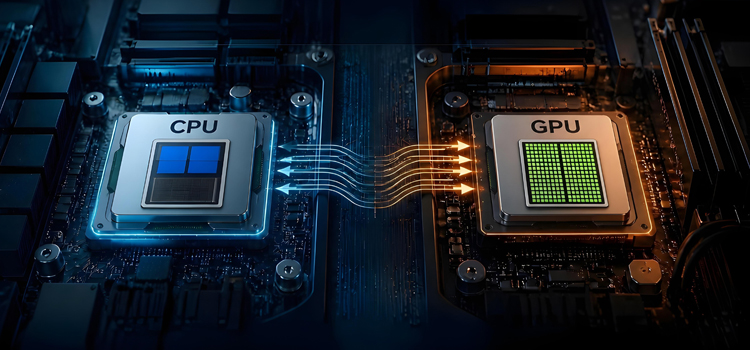
The emerging AI infrastructure stack is no longer CPU vs GPU–it is CPU + GPU by design:
- GPUs handle dense matrix computation (model inference and training);
- CPUs handle control flow, reasoning orchestration, and system logic;
- Networking and memory subsystems connect everything into a unified execution fabric
AMD’s strategy – tight coupling of EPYC CPUs with Instinct GPUs and a broader platform ecosystem – fits directly into this model, where performance is defined at the system level, not the chip level. Leading infrastructure vendors are converging on this same system-level design philosophy, optimizing performance through integrated CPU–GPU–network architectures rather than individual component optimization.
What this means for the industry
The 46.2% revenue share milestone is therefore less about market dominance and more about direction:
- CPUs are becoming first-class citizens again in AI infrastructure;
- Demand is shifting from “more GPUs” to “balanced compute systems”;
- Agentic AI is redefining bottlenecks from compute to orchestration;
- Data centers are evolving into multi-layered AI execution platforms
For partners and system integrators, this trend increases demand for balanced CPU + GPU reference architectures rather than GPU-centric designs. Integration complexity is also rising, particularly around orchestration, data movement, and cross-layer optimization, shifting value toward providers capable of delivering end-to-end AI system design and tuning rather than standalone hardware integration.
Conclusion
AMD’s EPYC growth reflects a broader transformation: AI is no longer a purely GPU-driven workload. With agentic systems introducing complex orchestration, decision-making loops, and tool execution, CPUs are regaining strategic relevance inside modern data centers.
In this new architecture, GPUs may generate intelligence, but CPUs increasingly decide how, when, and where that intelligence is applied.