
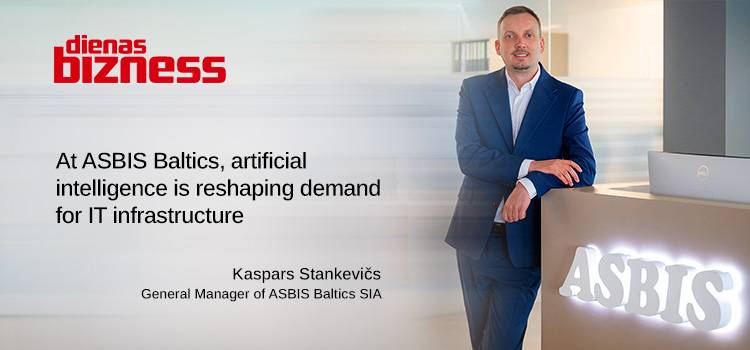
ASBIS Baltics Navigates AI-Era Opportunities with Record Results and Diversified Growth
In a recent interview published by Dienas Bizness, aLatvian business news media outlet covering economics, companies, and market developments in Latvia and the Baltic region, Kaspars Stankevičs, General Manager of ASBIS Baltics SIA, shared insights on the company’s record performance in 2025, the impact of artificial intelligence on the IT hardware market, and the group’s long-term strategic direction.
Record results driven by AI-related demand
Stankevičs confirmed that 2025 became the strongest financial year in the company’s history. ASBIS Baltics SIA achieved approximately €47 million in turnover, €5 million in gross profit, and around €1.5 million in EBITDA. Growth reached roughly 16% year-on-year, supported primarily by rising demand for IT components.
A key driver behind this expansion has been the global surge in demand for computing infrastructure linked to artificial intelligence. Increased consumption of RAM, SSDs, servers, and other core hardware components has significantly boosted sales across all business lines.
AI boom reshaping global supply chains
According to Stankevičs, large technology companies such as Microsoft, Google, and Amazon have been rapidly increasing procurement of computing resources, creating structural shortages in the semiconductor and memory markets. He warned that supply constraints could persist until around 2030, as manufacturing capacity struggles to keep pace with demand.
This imbalance has created both opportunity and risk for distributors like ASBIS: while demand remains strong, the industry is increasingly challenged by the inability to fulfill contracts on time and at stable pricing.
Three core business directions
ASBIS Baltics SIA operates across three main segments:
- IT component wholesale, including processors, storage devices, and computer hardware from global manufacturers such as Intel, AMD, Samsung, Kingston, and others.
- Retail distribution, supplying consumer electronics and lifestyle products through retail chains, featuring brands like Logitech and Bang & Olufsen.
- Project and solutions business, delivering integrated IT ecosystems such as servers, networking equipment, and workplace collaboration systems for enterprises and public sector clients.
The third segment is increasingly important but also more complex, involving long sales cycles, detailed technical planning, and close cooperation with implementation partners.
Expansion of own brands and new technologies
The company continues to develop its proprietary brands, including AENO, CANYON, LORGAR, and Prestigio Solutions, focusing on consumer electronics, gaming products, and professional display solutions.
Stankevičs also highlighted emerging growth areas, including automation and robotics, as well as the refurbished smartphone market, where ASBIS operates production facilities in Poland, Ukraine, and Kazakhstan. These initiatives are positioned as both economically efficient and environmentally sustainable.
Regional performance and market differences
Within the Baltic region, Lithuania remains the strongest growth market, supported by higher economic activity and broader geographic distribution. Latvia is positioned in the middle of the region’s performance, while Estonia is experiencing weaker demand and slower growth due to macroeconomic and tax-related pressures.
Compliance, geopolitics, and Ukraine support
The company reiterated that it has fully exited the Russian and Belarusian markets. ASBIS maintains strict AML and KYC compliance procedures, including continuous sanctions screening and centralized approval of business relationships.
At the same time, the group has provided more than €5 million in humanitarian support to Ukraine, including equipment donations such as generators and medical devices, while maintaining operational presence in the country.
Outlook: growth with caution
While the AI-driven demand environment continues to support strong results, Stankevičs emphasized a cautious outlook due to persistent supply constraints and increasing market uncertainty. Future development is expected to focus on AI infrastructure, integrated IT solutions, robotics, and circular economy initiatives, including refurbished electronics.
Despite structural challenges in the global supply chain, ASBIS Baltics SIA sees continued opportunities for growth through diversification, deeper technical expertise, and expansion of its solution-based business model.
Source: Dienas Bizness