
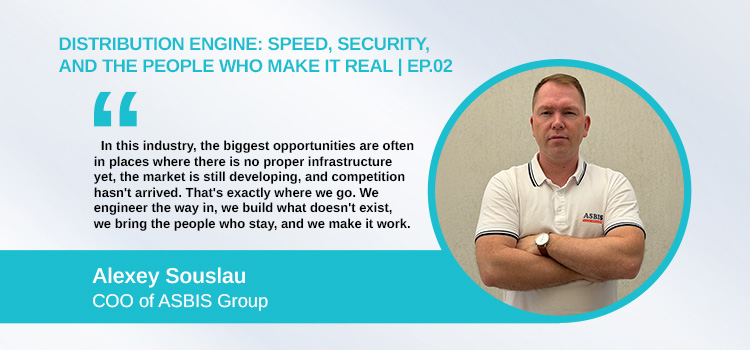
Speed, Security, and the People Who Make It Real: A Look Inside ASBIS Operations
This interview features insights from Alexey Souslau, COO at ASBIS Group, exploring how operational excellence, local expertise, and people-first leadership enable ASBIS to scale secure, high-speed IT distribution across highly diverse international markets. The discussion highlights the company’s approach to infrastructure resilience, operational agility, automation, security, and the evolving role of human expertise in an increasingly AI-driven supply chain environment.
Q: ASBIS operates across a highly diverse EMEA region. What makes managing such scale possible?
A. S.: Scale at this level doesn’t happen by accident. We carefully engineer, maintain, and improve it every single day. What makes it work at ASBIS is the combination of strategically positioned physical infrastructure, sophisticated systems, and the daily dedication of our people. We’ve built strategically located distribution hubs and warehouses across EMEA, not just for coverage but for resilience as well. When one corridor is disrupted, the network absorbs the impact, and we go on.
However, infrastructure alone isn’t enough. The real differentiator is how we’ve synchronized people, processes, and technology across markets with fundamentally different dynamics. That synchronization turns a collection of regional operations into a single, scalable mechanism. We stay focused on this synchronization, bringing uniformity to processes and systems and encouraging the sharing of knowledge among teams and subsidiaries.
Q: What differentiates ASBIS operationally from a traditional distributor?
A. S.: We have very little hierarchy between management and the people doing the physical work. I walk the floors together with the warehouse men when visiting the DCs and local warehouses. We go through the processes and take immediate actions to improve the operations that can be confirmed there and then, not following endless meetings and hierarchical approvals. When we open new subsidiaries, warehouses, or shops, we go there to support them firsthand. We meet our service providers regularly, in person, reviewing the operational KPIs, discussing the drawbacks, and making sure that the dialogue goes both ways; in turn, they provide us with cost-effective solutions and offer full-scale support for our new projects. The hands-on culture in ASBIS is something that we protect deliberately. It’s what keeps people here for many years, and it’s what allows us to take on new challenges and move fast.
Q: Why is geography such an important advantage in modern IT distribution?
A. S.: In this industry, the biggest opportunities are often in places where there is no proper infrastructure yet, the market is still developing, and competition hasn’t arrived. That’s exactly where we go. We engineer the way in, we build what doesn’t exist, we bring the people who stay, and we make it work. That’s not a strategy you can copy overnight. It takes years to build and compounds every single day. The local relationships, the compliance frameworks we’ve built market by market, take years to establish and are nearly impossible to shortcut. By the time a competitor decides that a certain market is worth entering, we’re already there and already own the operational trust.
Q: How important is operational speed in the current EMEA market?
A. S.: Consumer expectations are rising when it comes to the speed of delivery of goods. The count now goes in hours and no longer in days. The same can be said about B2B sales across EMEA, where our partners and vendors have fundamentally reset their expectations. Meeting that expectation across 50+ markets simultaneously requires infrastructure that ASBIS has built, and most of the other companies simply don’t have.
I must add that speed matters, but not at the expense of security and accuracy, especially with the products we handle. We know how to move fast and establish significant infrastructural projects within days. But speed must be paired with rigorous processes and security policies. We deal with high-value electronics, and our teams are trained to treat security as non-negotiable, from how goods are received to how they’re stored, to how they’re handed over to our secure freight forwarders.
Q: What role does technology play in ASBIS operations today?
A. S.: What I’ve learned over the years is that the best operational systems are the ones your teams trust, understand, and most importantly use. Most of our developments are directly catering to business needs, as described to us by our people. When the system addresses a certain need or automates a certain process, brings accuracy and saves a significant amount of time, there is a much higher probability that the person will use the functionality, and hence, the productivity grows. We continuously work on unifying processes across the group, and technology is there to help. We use both vendor-developed solutions and our own developments, making sure every aspect of business is covered.
Q: What makes building operations across EMEA especially challenging?
A. S.: What makes EMEA genuinely complex isn’t just regulation or logistics infrastructure; it’s different working cultures, different expectations, and different relationships with the authorities. What works in Prague doesn’t automatically work in Dubai, Accra, or Abidjan.
Our approach has always been to hire people who understand their local context deeply, give them real ownership of their work, and keep the hierarchy flat enough that they can act without waiting for permission from three layers above. That autonomy, combined with a shared operational culture we’ve built over many years, is what holds the whole network together.
Q: How do you see the future of IT distribution evolving?
A. S.: More automated and robotized for sure, and very AI-dependent. Technology will be there to help, but the industry will still be dependent on exceptional people. The complexity of what we do is increasing: higher-value products, more demanding security requirements, more sophisticated supply chains. Ever-changing geopolitical situations are disrupting everything, from logistics to businesses, the whole industry. You can automate the repetitive; you cannot automate the judgment calls that come with moving critical IT infrastructure across diverse markets and force majeure situations. Those calls require experienced people who have genuine ownership of their work. The companies that will lead this industry are those that invest in automation and in the people working alongside it. At ASBIS, that’s exactly the balance we’re focused on.
Q: What are you personally most proud of in ASBIS operations?
A. S.: In this industry, high turnover of people on the warehouse floor and wider operations department is just viewed as normal. We’ve never accepted that. We’ve built an environment where people come in, develop real skills, take ownership of their work, and most stay for many years. That’s not an accident. It comes from treating the shop floor with the same seriousness as any other department. Revenue growth, geographic expansion, and automation investments none of it delivers without the people underneath it who make it work every day. I believe our people are our best accomplishment.